

Earlier this year, when Andrej Karpathy described the LLM Wiki, a lot of Mem users probably smiled the way we did: that is already how we work. So we built our reading surface around it and shipped it in v0.8. Keep your knowledge as many small markdown pages, each focused on one entity or topic, cross-linked, with an index you can navigate. The LLM does the bookkeeping; you curate.
Google Cloud’s Knowledge Catalog team introduced the Open Knowledge Format (OKF) in June. It takes that same pattern and writes it down as a spec. In the words of Sam McVeety and Amir Hormati, who introduced it, OKF “formalizes the LLM-wiki pattern into a portable, interoperable format.” Reading that line gave us the same familiar feeling: this is the thing we have been building all along, only now it has a name and a shape other tools can read.
So we read the spec, held it up against what Mem already produces, found that most of it lined up, and shipped an OKF export. You can try it today.
Updated July 31, 2026: Google published OKF v0.2 on July 24. Mem’s current Rust exporter now emits v0.2 bundles, including the format’s trust and lifecycle fields. This article has been updated to describe that shipped surface.
What OKF is
OKF is deliberately small. A knowledge bundle is a directory of markdown files with YAML frontmatter. Nothing more.
---
type: Entity
title: Nowledge Mem
description: A cross-tool personal knowledge graph.
resource: nowledgemem://entity/3d96905c
tags: [product]
generated:
  by: nowledge-mem/0.10.48
  at: 2026-06-14T00:00:00Z
---

# Nowledge Mem

Mentioned across your memories, linked to the topics it belongs to.
The only always-required field is still type. Links between concepts are ordinary markdown links, index.md gives you a table of contents, and log.md records history. In v0.2, generated records who produced a concept and when; sources carries claim-level provenance; verified and status carry trust and lifecycle state. The format stays small, but it can now preserve more of what makes knowledge trustworthy.
The point of keeping it that small is in the post’s own framing: “What’s missing is a format, not another service.” A bundle is just markdown, so it renders on GitHub and opens in any editor. It is just files, so it ships as a folder or a tarball and lives in version control next to the code it describes. And it is readable by a person and parseable by an agent at the same time, with no translation layer in between.
Why this fits Mem so well
Honestly, Mem has been emitting almost exactly this for a while. Our Knowledge Filesystem already projects the graph as markdown with frontmatter, and the Library’s Wiki Export already ships a portable folder. What OKF added is the one piece we could not give ourselves: a spec everyone agrees on. With that, the bundle we write is one other tools already know how to read.
Closing the gap was mostly careful bookkeeping. OKF reserves type for the kind of concept, so an entity’s type: Entity carries its person-or-product kind in a separate field. Links are written as file-relative markdown paths, and each directory gets its own index.md. In v0.2, a memory or crystal can also carry its producer, sources, review state, and lifecycle state in the standard fields. None of this changes how Mem runs. It changes what survives in the bundle on the way out.
What you get
The Library’s export button now offers two formats:
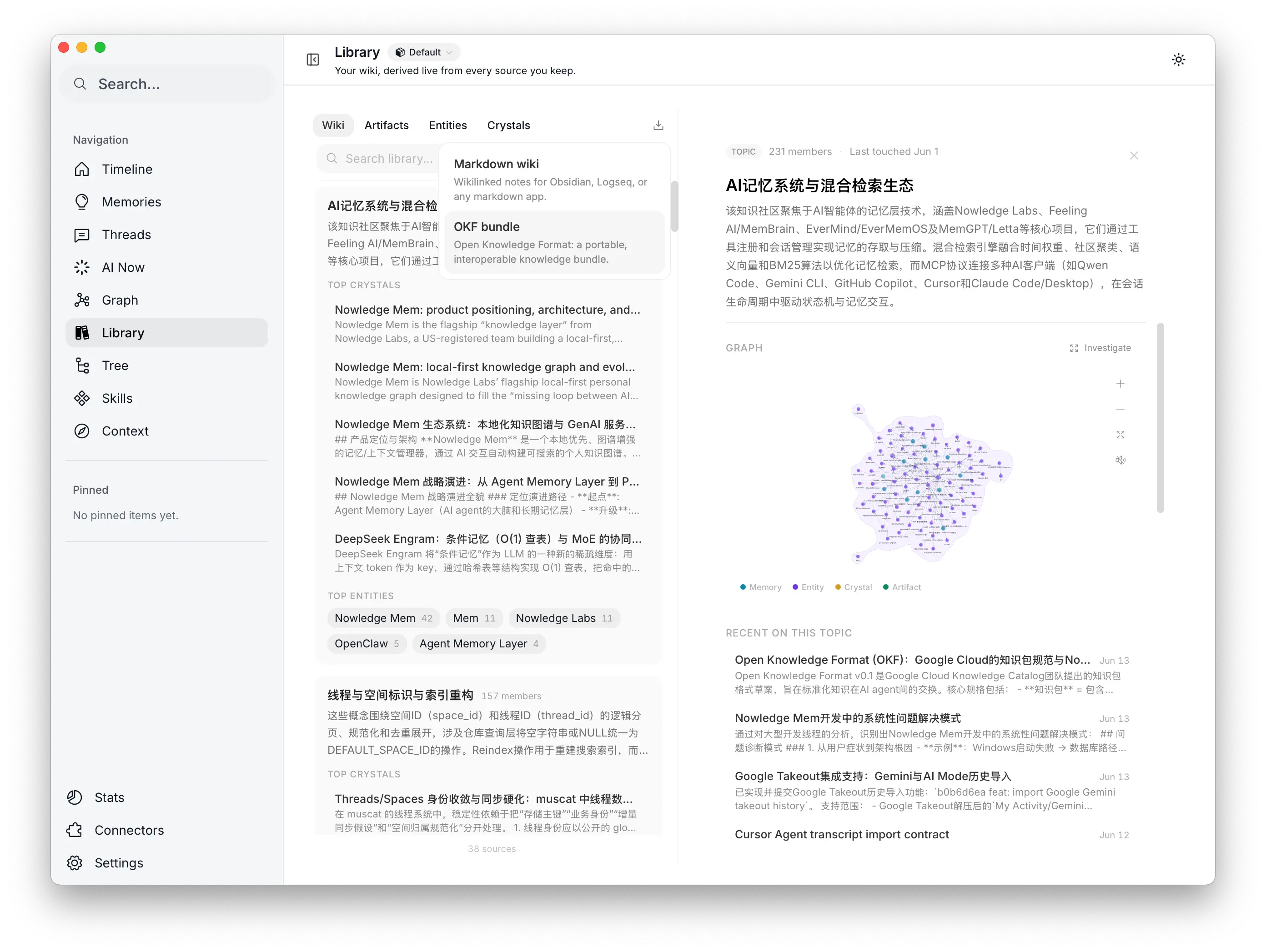 Exporting an OKF bundle from the Library in Nowledge Mem
- Markdown wiki is the same Obsidian-flavored folder you already had:
[[wikilinks]], ready to drop into Obsidian, Logseq, or any markdown app. - OKF bundle is the vendor-neutral version. The current exporter covers memories, topics, entities, crystals, and the label catalog, with file-relative links and v0.2 trust and lifecycle metadata.
We test the exporter against Google’s reference implementation rather than only our own parser. Representative v0.2 concept documents pass its validator; the reference viewer resolves the bundle’s links; and our conformance checker also validates Google’s own v0.2 sample bundles. Artifacts and skills are still documented follow-ups in the current Rust exporter, so this is an OKF export of Mem’s core knowledge graph, not a claim that every Mem object is already covered.
Both exports are a snapshot, not a sync target. Edit the files outside Mem and the changes do not flow back. Want a fresh copy? Export again.
Credit
The credit here belongs to the OKF authors and the Knowledge Catalog team. They did the harder and more generous thing: instead of shipping one more proprietary surface, they specified an open format and invited everyone to use it. Their post is explicit that “contributions, alternative implementations, and adoption beyond Google products are all explicitly welcomed,” and that “the format itself is the contribution.”
We are happy to be among the first to pick it up, and we want to give something back. OKF v0.2 added standard trust and lifecycle fields, and Mem now maps its real review and lifecycle data into them. Mem still carries richer bi-temporal history and evolution chains that do not fit the format completely, and those feel worth bringing upstream rather than disguising as full support. For now, the most useful thing we can do is keep our export conformant, portable, and honest about its coverage.
Try it
- Open the Library and switch to the Wiki tab. If it is empty, open the Graph view, run community detection once, and come back.
- Click Download on the tab row and pick OKF bundle.
- Unzip it. Open
index.mdin any markdown reader and click your way through the topics, entities, and crystals. - Drop the folder into Google’s reference viewer, or any other OKF tool, and read the same knowledge somewhere else entirely.
Download Nowledge Mem · Library docs · Read the OKF spec · Read Google’s announcement